Timur conquered from Delhi to Damascus and destroyed much of what he took. What he spared were the craftsmen. Builders, tile-makers and calligraphers from Iran, Iraq and Syria were sent to Samarkand, his capital, and set to work making it the most splendid city of his age.
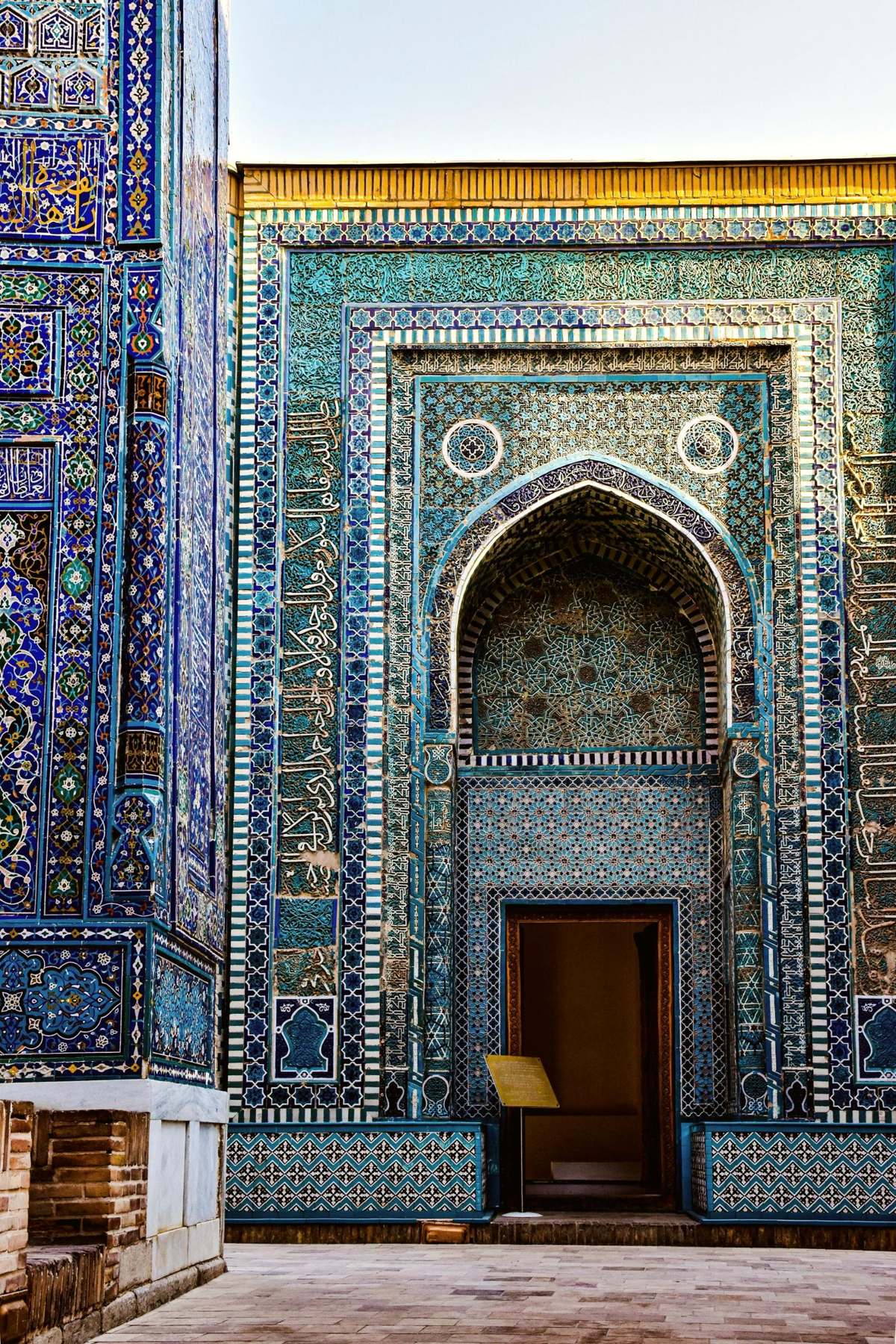
Their signature was blue. Not one blue but two: a deep cobalt that turns almost violet at dusk, and a bright turquoise that seems to give off its own light at noon. Set against each other and against the warm, unglazed brick behind them, they made buildings that announced themselves from far across the plain.
They have lasted because of chemistry. Cobalt blue comes from cobalt oxide, turquoise from copper in an alkaline glaze. Both are minerals rather than dyes, and in the kiln they fuse into a skin of coloured glass. The sunlight that bleaches a carpet within a decade has nothing to work on. What harms Timurid tile is water, salt, earthquakes and neglect, which loosen it from the wall. The colour itself stays as it left the kiln.
The best place to see the full range is Shah-i-Zinda, the avenue of tombs on the edge of the old city. Built over some seventy years for Timur's family and commanders, it reads like a catalogue of everything his craftsmen knew: glazed bricks laid in patterns among plain ones, mosaics of tiny cut pieces fitted like a puzzle, tiles painted in several colours before firing, and terracotta carved in deep relief and then glazed. Look for the tomb of Shodi Mulk Oko, built in 1372 for a sister and niece of Timur, where the joints between the carved tiles almost disappear.
Not every surface you see is original. Samarkand's monuments were heavily rebuilt in the Soviet period and again in recent decades, and several of the Shah-i-Zinda tombs were restored in 2005 in ways that many specialists regretted. A good guide will show you where old ends and new begins. The difference is worth knowing. Old tile has a depth and unevenness that no modern glaze quite matches.
End at Gur-e Amir, where Timur himself lies beneath a ribbed turquoise dome. Come in the last hour of light, when the cobalt deepens and the gilded interior glows through the doorway. Six centuries on, it is still the colour of the city.