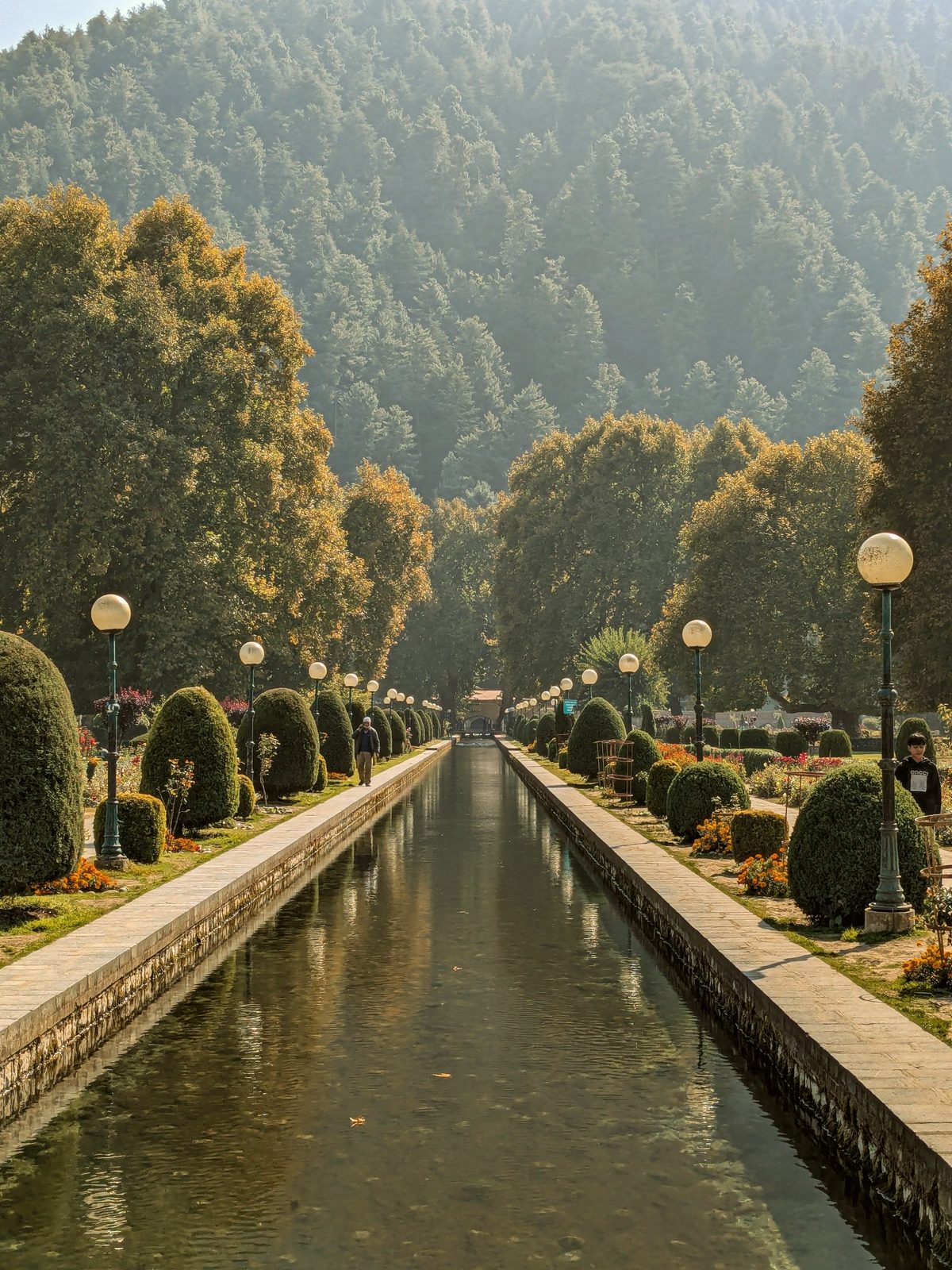
A Mughal garden is not a place to wander. It is a proposition, laid out in water and stone, about how the world ought to be ordered.
The form is the charbagh, the fourfold garden. A square is divided by water channels into four parts, which may be divided again, and again. Its roots lie in the gardens of Persia and of Timur's Central Asia, and Babur, the first Mughal emperor and a descendant of Timur, carried the idea into India. In his memoirs he complained of the heat and disorder of his new kingdom. His answer was to build gardens.
The four channels recall the four rivers of paradise described in the Qur'an, of water, milk, wine and honey. The garden argues that paradise can be approached on earth, given enough water, geometry and labour. The word itself makes the case: our 'paradise' comes, by way of Greek, from an old Persian word for a walled garden.
In Kashmir the argument was made with the landscape's help. Jahangir laid out Shalimar Bagh beside Dal Lake around 1620, with water from the hills running down through terraces shaded by chinar trees. It remains one of the loveliest places in the subcontinent to spend a morning.
His son Shah Jahan wanted the same in Lahore, where there were no hills to help. Begun in 1641 and finished the following year, Lahore's Shalimar Gardens bring water by canal and let it fall over three broad terraces into marble pools and hundreds of fountains. From the upper terrace the whole plan lies open, its order visible at a glance. That was the point.
Shah Jahan's most famous garden made the argument most boldly. At the Taj Mahal the tomb does not stand at the centre of its charbagh, as Humayun's Tomb in Delhi does, but at the far end, above the river. The garden becomes the approach, and the building its conclusion.
Visit any of them early, before the heat and the crowds, when the channels are still and hold the sky. Walk the central axis once, then sit at its head and look back the way you came.